Learning material

These resources will be especially relevant for Learning and Development staff. They relate to a wide range of learning material, including Powerpoint presentations, e-learning, and reflective exercises.

Cultural humility (e-learning)

Cultural humility is a practice of self-reflection about how our own backgrounds and the backgrounds of others can impact on our relationships. It is relevant to creating an inclusive, equitable and diverse culture in health and social care. This resource has been designed to support development of cultural humility values, attitudes, and behaviours. Included are several videos which explore the experiences of health and social care workers from varied cultural backgrounds working in Scotland.

Two workers talking across a table

Understanding age in Child Protection guidance and Adult Support and Protection legislation (one-page explainer)

This one-page explainer sets out what can be found in the resource Understanding age in Child Protection guidance and Adult Support and Protection legislation. It explains how to get the most out of the resource, especially for those working with 16 and 17 year olds. This one-page explainer also contains additional reflective questions to consider and ideas for group learning sessions on the topic.

Picture of teenagers

Human trafficking (e-learning)

This e-learning provides an overview of the extent of human trafficking in Scotland and supports professionals to spot the signs indicating risks to individuals. There is also some practical information about the health needs of trafficked people, with an emphasis on a practitioner's role in identifying and responding appropriately to trafficked individuals.

This e-learning is part of TURAS and a free account is required to access the resource.
Man walking up a path (image from TURAS)

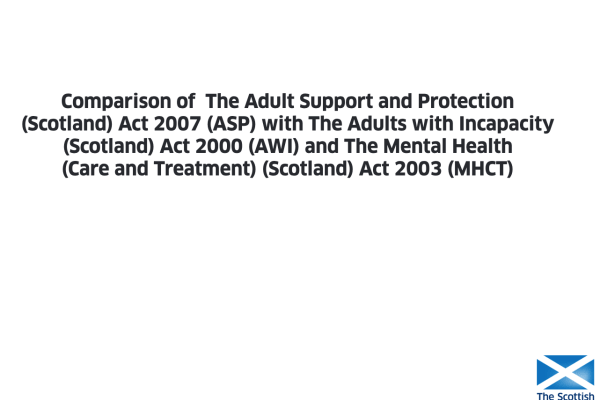
Comparison of the Adult Support and Protection (Scotland) Act 2007 (ASP) with the Adults with Incapacity (Scotland) Act 2000 (AWI) and the Mental Health (Care and Treatment) (Scotland) Act 2003 (MHCT)

This document contains several tables, each of which provides short extracts from the Acts for comparison purposes. These include:

  • Who is subject to the provisions of the ASP, AWI and MHCT Acts
  • A short overview of Orders, Warrants and Certificates
  • The principles
  • Duty to investigate / inquire
  • Duty to co-operate
  • Entry to premises / visits
  • Medical assessment/examination/treatment
  • Examination of records
  • Banning orders / interdicts
  • Urgent action
  • Financial interventions
Cover of comparison report

Adults with Incapacity (AWI) for Health, Social Work and Social Care: Learning resource

This learning resource is designed to support the development of knowledge and understanding of the Adults with Incapacity (Scotland) Act 2000. It aims to support and promote people’s rights in the application of the Act in health, social work and social care.

Included with this resource is an eLearning module, principles of the AWI Act, a podcast, a quick guide, a 'mythbusting' section and a resource library. It is part of TURAS and a free account is required to access the resource.

Screenshot of AWI Act

National Referral Mechanism (NRM): Toolkit for first responders in Scotland (Migration Scotland)

This toolkit clarifies the National Referral Mechanism (NRM) process for Scottish First Responders by explaining the process in detail and in an easy-to-follow format. It aims to help ensure that the quality of information included in NRM referrals is high, and that first responders better understand the implications of a referral and the NRM process.

Please note: this toolkit does not reflect the most recent range of provisions within Part 5 of the Nationality and Borders Act or the amendments to the Reasonable Grounds (RG) test.

Image of a woman with a hand reaching out to her

The ASPire Hub is a place for everyone working in Adult Support and Protection in Scotland to access and share resources. It is regularly updated and we welcome feedback and new additions!