Local guidance and frameworks

The local guidance and frameworks in this section have been shared to help other areas develop their own versions. Each entry includes information on how the template can be shared or adapted by other local areas.

Professional curiosity: Practitioner's guide and toolkit

This practitioner's guide has been produced by Perth and Kinross Child Protection Committee in partnership with practitioners from NHS Tayside and Children and Families' Social Work. It aims to provide all practitioners working directly or indirectly with children, young people and their families in Perth and Kinross, with clear practice guidance on how to be professionally curious and use this approach in the course of their work.

Information entering a funnel

Practitioner’s guidance: Professional curiosity (Tayside)

Professional curiosity is about exploring and understanding what is happening with an adult at risk and their family. This practitioner's guidance has been produced by the three Tayside Adult Protection Committees based on the Perth & Kinross Child Protection Committee (CPC) guidance. 

This practitioner's guidance covers what professional curiosity is, the barriers to using it, courageous and difficult conversations, and effective use of supervision to support curious and authoritative practice.

Cover of guidance

Adults with hoarding behaviour guidance (Renfrewshire)

This guidance describes what is meant by hoarding, the types of behaviour exhibited, and what the impact may be on the individual and those around them. It outlines three broad approaches to addressing hoarding behaviour (single agency response, formalised multi-agency complex case management, and investigations under the Adult Support & Protection (Scotland) Act 2007).

Cover of guidance

Human trafficking and exploitation: Multi-agency guidance (Scottish Borders)

The purpose of this guidance, from Scottish Borders, is to support an effective and robust response to any adult and child potential victim of trafficking, to ensure they receive the support they are entitled to, are protected and able to recover from their experience. The guidance includes a comprehensive definition of human trafficking and details of the relevant legislation. There is also a series of appendices setting out the roles and responsibilities of different agencies involved.

Cover image of guidance

Identifying and Responding to Hoarding: Good Practice Guidance (East Lothian and Midlothian Public Protection Committee)

This resource supports good multi-agency practice in identifying and responding to hoarding. It helps people to identify, understand and respond skillfully to hoarding in a trauma-informed way. The resource also outlines the responsibilities of the key statutory agencies. At the end, the guide has a useful checklist for managerial oversight of hoarding cases and a resource list of links to videos about hoarding, including input from adults who have lived experience of hoarding.

Cover of guide

Self-neglect and hoarding protocol and toolkit: Practitioner guidance (Orkney)

The aim of this Self Neglect and Hoarding Protocol and Toolkit is to provide practitioners in Orkney with a toolkit for assessment and intervention, where appropriate. The guidance contains information on what hoarding and self-neglect are, legal duties, and good practice principles. There are additional information and images from the Clutter Image Rating Scale (CIRS) and the practice implications of each level.

Cover of guidance

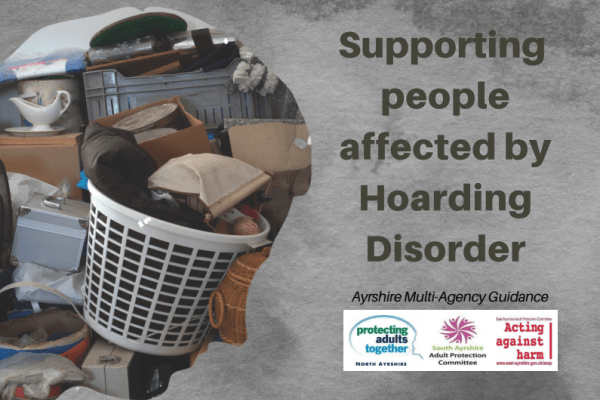
Supporting people affected by hoarding disorder (Pan Ayrshire Partnership)

This guidance is intended to provide a concise overview of what hoarding is. It outlines some of the issues that practitioners should take into account when supporting or providing a service to people affected by hoarding disorder. The resource includes two case studies, information on the Clutter Image Rating Scale (CIRS) and a process flowchart.

Cover of booklet

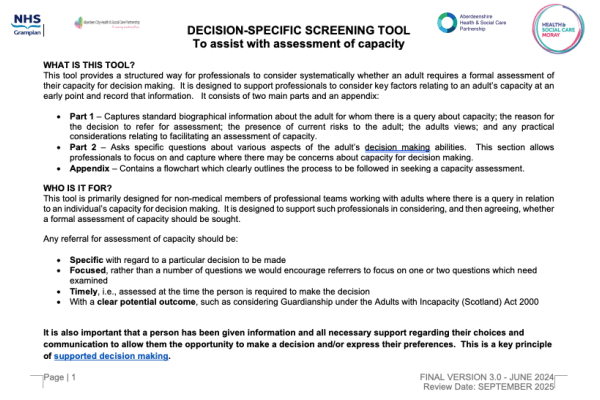
Pathway for capacity assessments for protection-based decisions (Grampian): Screening tool

This tool provides a structured way for professionals to consider systematically whether an adult requires a formal assessment of their capacity for decision making. It is designed to support professionals to consider key factors relating to an adult’s capacity at an early point and record that information. This document is featured in the Grampian pathway for capacity assessments for protection-based decisions.

Image of screening tool

The ASPire Hub is a place for everyone working in Adult Support and Protection in Scotland to access and share resources. It is regularly updated and we welcome feedback and new additions!