About the author
Gillian Ferguson is Doctorate in Health and Social Care Programme Leader at The Open University. She is a registered social worker in Scotland and remains active in practice alongside her academic role. She has worked in a broad variety of settings including direct practice, workforce development, advisory and regulatory roles, including as a social worker, community learning worker and academic.
Social workers’ learning in Scotland
Social work is an extraordinary job rarely understood by anyone that has not been immersed in it (Ferguson, 2025) and the profession is regularly described as at the cusp of transformation (McCulloch, 2018). There are multiple challenges in supporting social workers to learn, in practice learning arrangements at the pre-qualifying stage and inconsistency in what is offered post-qualifying (Kettle et al, 2016; Gordon et al, 2019; Grant et al, 2022). As 2026 brings the emergence of a new Social Work Partnership and a refreshed Framework for Social Work Education in Scotland, there are new opportunities to imagine the shape of how learning happens and how we support this in Scotland.
A recent focused book, The Scottish Social Worker’s Practice Learning Handbook (Ferguson, 2025), could be mistaken to be an individual social worker’s guide. Instead, this takes a journey through our rich tradition of creative approaches, our treasure chest of research and history of authentic partnerships that support social work learning and development. Building on this foundation, the book suggests that reflecting on what we mean by learning environments can help us create a future in which everyone is a learner, an educator and a leader (whether they realise it or not).
Learning and practice
Learning in practice has been a priority in Scotland for decades. Supporting learning was identified as being ‘everyone’s business’ (SSSC, 2004:9), a call repeatedly echoed (Kettle et al, 2016; McCulloch and Taylor, 2018). Research has continued to push the importance and value of learning (McCulloch et al, 2024) including learning in the workplace (Ferguson, 2023).
“While there have been significant shifts in understanding learning as a continuum of informal and formal activities, a tension remains in that individuals and organisations continue to place emphasis on training and tangible outputs in what they plan and value (Gordon et al, 2019; Ferguson, 2022; McCulloch et al, 2024). Research from social workers in Scotland consistently reports that some of the most valuable learning for them has come from direct practice experiences (Grant et al, 2022: Ferguson, 2023; McCulloch et al, 2024).” (Ferguson, 2025: 17)
Social work is ‘a practice-based profession’ (IFSW, 2014:2) and it is impossible to separate learning from practice. Learning comes from practice and knowledge generated informs practice in a natural cycle. While this seems clear, we often plan for learning in a way that is separate to other strategic developments. The connections between learning, research and practice are not always made with efforts to plan with one area of the system, sometimes undermining activity in another (McCulloch et al, 2024). We have the chance now, as a new Social Work Partnership comes into being, to consider the whole system of social work in which learning is an integrated part.
Influences on learning
What social workers are expected to learn is influenced by multiple intersecting policy and practice drivers. Learning is also influenced by key players (Figure 1) who must draw together for a cohesive practice and learning system.

People who use services and practitioners are at the heart of any professional learning. Scottish research reminds us that the journey of a social worker’s learning is a deeply personal, embodied process in which they navigate the complex expectations of role and work tasks (Ferguson, 2023; Grant et al, 2022). Leadership for learning is imperative at individual, organisational or strategic levels whatever our roles.
“There need to be concurrent interventions that support the whole system sustainably; governance/structures, recruitment/retention, training, leadership, improvement, and culture cannot be tackled in isolation.” (Martin, 2024:40)
From environments to ecosystems
Reflecting on ideas about learning environments for social work can help us realise how much influence we have. The quality of the learning environment is fundamental to whether people will learn (Wareing and Ferguson, 2024). Ideas about learning environments, cultures and communities of practice have influenced workforce development in social work over the last few decades. For example, creating a learning environment is a core part of the practice educator curriculum.
The learning environment is often thought about as the direct space or place that a learner occupies, their desk, their equipment, or the team area that they are sitting in within a workplace. The learning environment is however much broader than this immediate physical space. The components of a learning environment in health and social care (Figure 2, below) are depicted by Wareing and Ferguson (2024) showing intersecting elements, relevant for social work specific environments too.
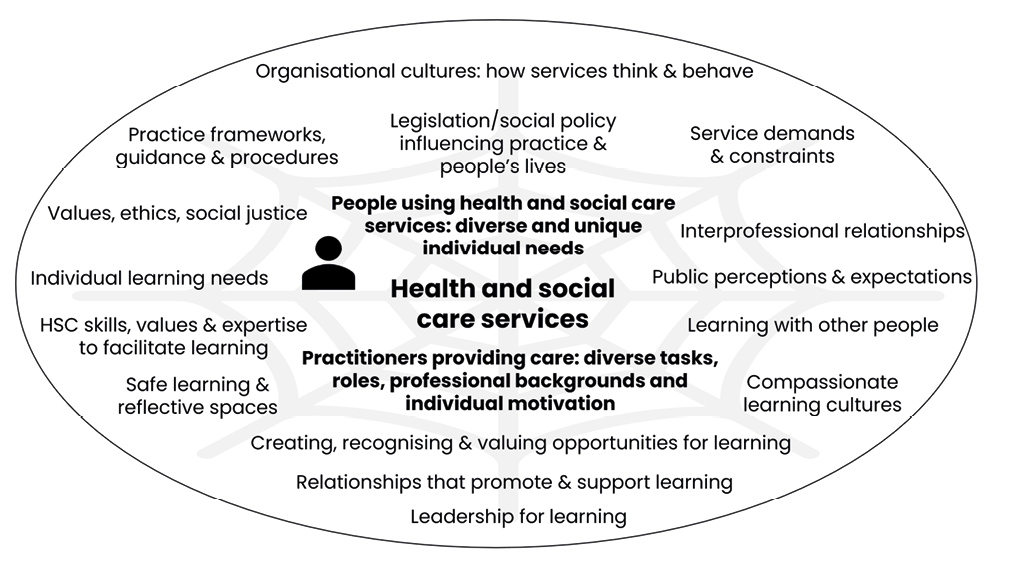
The workplace, and therefore the learning environment is characterised by physical and non-physical elements; for example, legislation or policy that influence our lives, which services are funded, their priorities and any associated regulations, frameworks. Practice guidance and procedures are part of the learning context. Policy also directly influences the resources that are available for resourcing of learning and development. Service demands and constraints are a challenge for organisations and learners within them in relation to trying to balance delivery of services while managing staff shortages, funding cuts and increasing demands. We are also familiar in workplace learning theory in relation to what is either an expansive or restrictive learning environment (Fuller and Unwin 2014). This is either essentially what will enable learning in any environment or otherwise.
Communities of practice have also long been recognised as a way of imagining networks for learning in the professional field, recognising the importance of learning together and from shared expertise. Ideas have continued to evolve from communities and environments into thinking about whole landscapes for practice (Wenger Traynor & Wenger Traynor, 2015). It is within learning landscapes that Wenger-Traynor et al suggest that we learn to know. The landscape metaphor gives a sense of the shifting, dynamic and organic place in which social workers learn.
Cooke et al, (2026) remind us that spaces and places for connection are key within the professional learning landscape. Where social workers are positioned, both geographically and within organisational structures, continues to change in this landscape. Changes also influence opportunities to learn and support the learning of others. We know that social workers are essential for the learning of other social workers in their practice placements and continuing professional learning (Ferguson, 2023).
You might want to reflect on these questions:
- How is learning valued and promoted in your organisation or team?
- What are the policy and practice influences on the learning environment?
- What are the most important ingredients of an effective learning environment?
- Where are your opportunities to support learning in practice?
The ethos and culture of organisations characterise the landscape and experiences of learners. Organisational culture can be understood as beliefs, values, ways of thinking and behaving. Often these become habits and include the attitude to and value placed on learning. Theories about learning organisations have also been at the fore of practice educator training and developments in Scottish social services. Stemming from the work of Peter Senge, the organisation itself learns and is seen as a living system.
“A [learning organisation is a] place where people continually expand their capacity to create the results they truly desire, where new and expansive patterns of thinking are nurtured, where collective aspiration is set free, and where people are continually learning to see the whole (reality) together.” (Senge, 2006, p3)
Within a learning organisation the principles, practices and essences are part of a system that enables learning – a dynamic system. Reflective practices at individual and organisational level, or feedback loops (Argyris and Schön, 1978) are fundamental to learning in the system. Can we reimagine this way of truly learning as a profession across Scotland, as a dynamic system in which we learn, using the treasure trove of expertise available to us?
While this article scratches the surface of these different theories and ideas, they remind us of the complexity of context for social workers learning. The challenges that we face to provide high quality, consistent practice learning for students and rich continuing professional learning for the whole career can be understood in this context.
Learning ecologies
In simplistic terms, an ecology in nature is a system in which there are interactions and interdependencies between organisms and their environment. Within an ecology there are many examples of how natural regeneration can occur, for example birds reforesting areas through seed dispersal. While beyond the scope of this piece, reflecting on how dropping small seeds can result in huge changes to the nature and health of an ecosystem is helpful. Jackson (2019) suggests that learning ecologies are a special type of human system in which different elements influence one another positively or negatively.
“A system of people, content, technology, culture and strategy with multiple connections and feedback loops that enable growth.” (Jackson, 2019)
A vibrant learning ecosystem involves connections across people and systems that are encouraged to flourish. Everyone’s behaviour within such an ecology is fundamental to growth and where we choose to drop seeds or foster change matter. Leadership for learning is where energy, skills, experience and support are fed into the ecosystem from all levels. This is important because it shifts the focus of learning beyond individual responsibility of social workers, practice educators or those with a defined development remit to one where everyone is a learner, educator and leader. While not an individual responsibility, much relies on what individuals think.
- Who is responsible for leading learning?
- What are your opportunities to lead learning in social work?
- How would you visualise a cohesive, effective learning ecosystem for social work in Scotland?
Within a learning ecosystem, ideas of stewardship and systems convenors are central to pushing across traditional silos to harness potential learning capabilities within the landscape (Wenger-Traynor and Wenger-Traynor, 2021). A professional learning ecosystem needs people who understand and see the complexity of the landscape for learning and agitate for change in the places where they have power to do so.
Scotland has also embraced a few other key systems approaches to development including Human Learning Systems (Lowe, 2020), an approach to development which embraces the complexity of public services, key organisational change and systems thinking theories. The Scottish Government has also promoted Service Design approaches that focus on understanding the system and needs of people within (2019). Taking an ecosystem approach, professional learning for social work can therefore be supported by the ideology and tools which are widely available.
“Social work thinks systemically and uses ecological theories in relation to many areas of practice yet an overarching, connected approach to professional learning has been elusive in Scotland. In fact, social workers described their most significant learning experiences as being completely by chance.” (Ferguson, 2025:32)
Back to the future
Looking into the rear-view mirror shines a light on the current contextual challenges. We need to develop a picture that understands the past properly to help explore the future. Not in a melancholic nostalgia but in recognition of the wisdom and expertise in Scotland. There are three key sources of rich knowledge documented in Ferguson (2025) that are often either not fully known about or underused in designing new plans: the body of research related to Scottish social work education and continuing professional learning; the history of former, often inspirational, learning partnerships; and the expertise that people across social work practice and education in Scotland hold. Our history of authentic learning partnerships is an important point for reflection with just a few examples of these noted here:
- Four Scottish Social Services Learning Networks covering the whole of the country were centrally funded and previously led wide-ranging activity. They directly coordinated and often delivered training, including practice learning qualifications, and they led the sector on emerging agendas such as leadership, mentoring and coaching.
- The Scottish Practice Learning Project (SPLP) was a relatively well-resourced national initiative initially hosted by the SSSC before being amalgamated into it. One product of the SPLP was the development of quality standards and an audit tool for practice learning (SSSC, 2006) often still adapted for use in universities and organisations.
- Consortia for the delivery and assessment of post-qualifying training (Coles, 2002) have also been delivered through partnerships across Scotland. These were closed and funding discontinued.
- The Scottish Organisation for Practice Teaching (ScOPT), a membership organisation, was at the forefront of resources, information and activism for practice education until its sad closure in the early 2020s.
- The Social Work Education Partnership (SWEP) was created around 2019 in response to the review of social work education in Scotland and continues to develop.
As new visions emerge it is essential to learn from the ways in which previous partnerships have come and gone together with available evidence from research and sector wisdom. Fully understanding the past and recognising the expertise across all those identified in Figure 1 can help shape a future which has meaning for social workers in Scotland. Scharmer suggests that the ‘essence of leadership is about the capacity of the system in which everyone is participating, to sense and shape the future’ (Scharmer, 2021). While the challenges we face are many, Scotland has a fantastic community of people, relationships and opportunities for a vibrant professional learning ecosystem.
“There is a window of time now, in relation to seeing the system and aligning the planets, but this will go by and we can miss the opportunity.” (Mark, in Ferguson 2025:86)
References
- Cooke C, Crighton S and Ferguson G (2026) Reimagining professional learning: conversations across perspectives. The Open University
- Ferguson G (2023) ‘“When David Bowie created Ziggy Stardust” Reconceptualising workplace learning for social workers’, The Journal of Practice Teaching and Learning: Papers from the International Conference on Practice Teaching and Field Education in Health and Social Work, 20(1):67–87
- Ferguson G (2025) The Scottish Social Worker’s Practice Learning Handbook. London: Routledge
- Fuller A and Unwin L (2014) Expansive learning environments: integrating organizational and personal development, Chapter 8 in Rainbird H, Fuller A, Munro A (2014) Workplace Learning in Context. London: Routledge
- Gordon J et al (2019) Post-qualifying learning in social work in Scotland: A research study. Dundee: SSSC
- Grant S et al (2022) Newly qualified social workers in Scotland – a five-year longitudinal study. SSSC
- IFSW (2014) Global definition of Social Work, International Federation of Social Workers
- Jackson N (2019) Exploring Learning Ecologies, 2nd edition
- Kettle M et al (2016) Integrated Learning in Social Work: A review of approaches to integrated learning for social work education and practice. Dundee: SSSC
- Kettle M et al (2016) Integrated learning in social work: A review of approaches to integrated learning for social work education and practice. Dundee: SSSC
- Lowe T (2020) A human, learning, systems approach
- McCulloch T (2018) ‘Education for the Crossroads? A Short History of Social Work Education in Scotland’, Practice, 30:4: 227-237
- McCulloch T and Taylor S (2018) ‘Becoming a social worker: Realising a shared approach to professional learning?’, British Journal of Social Work, 48 (8): 2272–2290
- McCulloch T et al (2024) ‘Embedding Learning as a Practice of Value: Learning from the Experiences of Early Career Social Workers in Scotland’, The British Journal of Social Work, 54 (7): 2977–2995
- Scharmer O (2021) To change a system you have to have the courage to step into the unknown
- Scottish Government (2019) The Scottish approach to service design
- SSSC (2004) Confidence in Practice Learning. Dundee: SSSC
- SSSC (2006) Scottish Practice Learning Project – Standards and audit for practice learning opportunities – A quality process. Dundee: SSSC
- Wenger-Traynor E and Wenger-Traynor B (2021) Systems convening a crucial form of leadership for the 21st century. Sesimbra: Social Learning Lab