Iriss

Leading for outcomes: integrated working, Part two

Understanding and promoting an outcomes-focused approach in integrated working
Outcomes are discussed fully in the parent guide (Leading for outcomes: a guide) and you may wish to refer to exercises 1 and 2 on pages 11-18 of that guide as an introduction to the outcome categories, the benefits of an outcomes-focused approach, and for an understanding of how this approach differs from a service-led approach. By outcomes we mean the impact of support on a person’s life, and not the outputs of services. Outcomes are the answer to the question: so what difference does it make? They are the changes or benefits for individuals whether as service users or informal/family carers.

Leading for outcomes: Integrated working

Introduction

What is this guide?

This guide forms part of the Iriss Leading for Outcomes series. The guides are designed to support team leaders, managers and trainers to lead teams in the adoption and implementation of a personal outcomes-focused approach. The initial guide, Leading for outcomes: a guide, gives general evidence-based advice and support in leading this approach within the context of adult services.

Culture change - what is it all about?

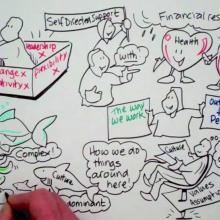
Creative storyboard based on Insight 17

Creative storyboard based on Insight 17 - Culture change in the public sector - written by Michelle Drumm (Iriss). It depicts how organisational culture change can be enabled and sustained and offers some evidence for how culture change happened in the Highlands in relation to the Getting it right for every child (GIRFEC) Highlands Pathfinder programme.

Self-directed support: a voyage of discovery

Evidence explorers project report

At times of change and uncertainty, evidence becomes very important to build confidence about how to put policy into practice. Although some relevant evidence exists, as it becomes the mainstream mechanism fordelivering social care, self-directed support (SDS) will bring significant new challenges and evidence needs.

Outcomes Toolbox

A toolbox of resources relevant to an outcomes-focused approach in social services

Developed by Iriss in partnership with Coalition of Care and Support Providers in Scotland (CCPS), the Outcomes Toolbox brings together a range of resources and knowledge relevant to an outcomes-focused approach in the social services.

It includes:

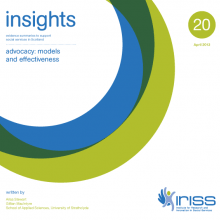
Advocacy: Models and effectiveness

Insight 20

Draws on evidence in relation to advocacy with both children and adults and on literature from the fields of health and social care. It outlines the key elements of the most prevalent models of advocacy and identifies good practice, as well as the limitations of advocacy models.

Capacity building for mobile learning

Simple and accessible tools to help you create, find and share learning materials

During 2012-13 Iriss, in partnership with the SSSC ran a series of workshops for people involved in designing or delivering learning.

Why?

The Knowledge Management Strategy for the social services recognises that web-based tools - social bookmarking, Twitter, newsfeeds, Google search and Facebook - are now widely used for communication, collaboration and learning.

Social Assets in Action: Evaluation Report

Commissioned by IRISS, East Dunbartonshire CHP and East Dunbartonshire Council

The Project aimed to incorporate strength-based practice in the delivery of mental health services by piloting Personal Asset Mapping, and to broaden awareness of community assets in order to show options outside of public service delivery including through developing a Community Well-being (asset) Map. This was intended to complement rather than replace attention to the needs of people who use services.

Social Services Expo and Conference 2013: Resources

Presentations and documents

This event was held on 19th March 2013 at Murrayfield Stadium, Edinburgh and was a collaboration between, ADSW, Care Inspectorate, COSLA, IRISS, SASW, SSSC and The Scottish Government